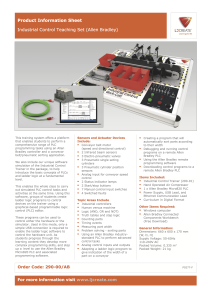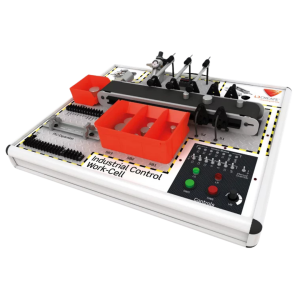
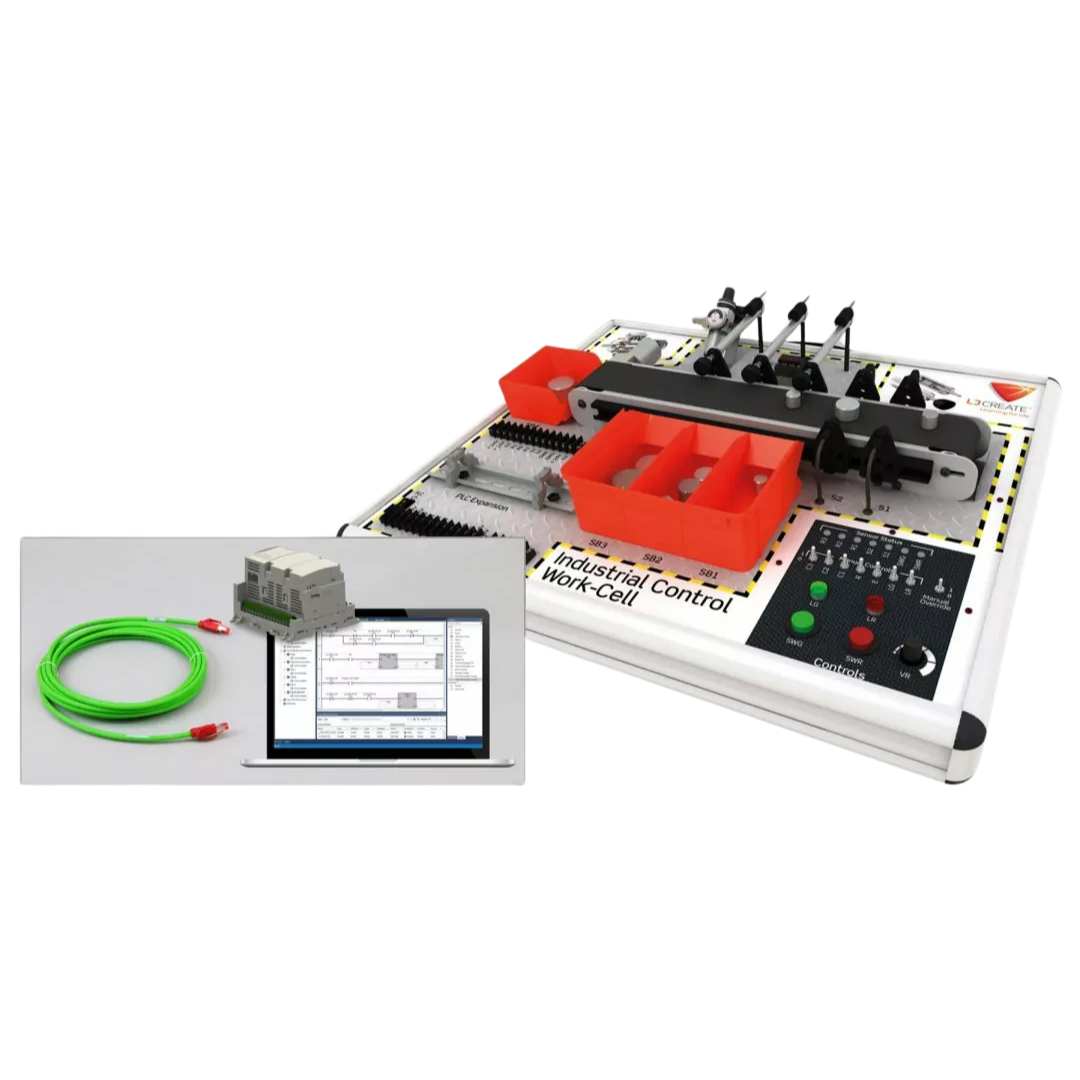
The AB Industrial Control Teaching Set – Allen-Bradley (290-00) is a hands-on industrial automation training system designed to teach foundational industrial control and motor control concepts using industry-standard Allen-Bradley PLC (Micro820 PLC).
This training system offers a platform that enables students to perform a comprehensive range of PLC programming tasks using an Allen Bradley controller and a conveyor belt/pneumatic sorting application.
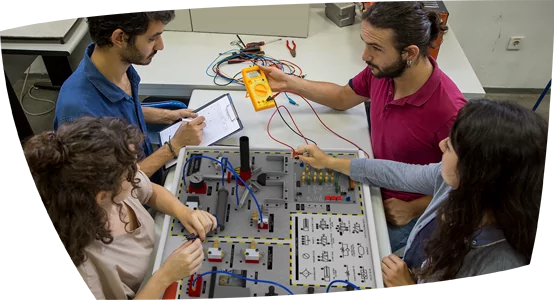
Through practical wiring, circuit building, and troubleshooting activities, students gain experience working with industrial electrical devices commonly found in manufacturing and automation systems.
Designed for industrial technology, engineering, and automation programs, this trainer helps learners understand how industrial control systems operate while building practical technical skills in electrical wiring, control circuits, and automation applications.
Features
- Hands-on industrial control training system
- Uses real Allen-Bradley industrial components
- Supports industrial wiring and motor control activities
- Reinforces automation concepts through practical application
- Supports troubleshooting and diagnostics training
Using the AB Industrial Control Teaching Set, students can develop skills in:
Industrial Control Circuits
Build and analyze industrial electrical control systems used in automation environments.
Motor Control Fundamentals
Understand motor starting, stopping, reversing, and control operations.
Industrial Electrical Wiring
Wire and connect industrial control devices using real-world components and practices.
Automation Systems and Components
Identify and understand the function of industrial automation hardware and control devices.
Troubleshooting and Diagnostics
Develop systematic troubleshooting skills for industrial electrical and control systems.
Curriculum & Program Integration
This trainer aligns with LJ Create’s Mechatronics and Engineering programs, where they’ve paired engaging curriculum and hands-on learning.
The curriculum for this learning system includes:
- Hands-on training experiments and activities
- Interactive online curriculum and instructional resources
- Teacher support materials and guided learning content
LJ Create trainers can be implemented as standalone learning systems or combined into larger pathway-based programs to support technical education initiatives.
AB Industrial Control Teaching Set Product Details
System Includes
- Allen-Bradley industrial control components
- Industrial motor control devices
- Wiring and connection hardware
- Industrial control training platform
- Instructional materials and guided activities