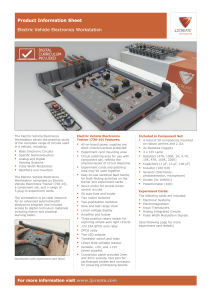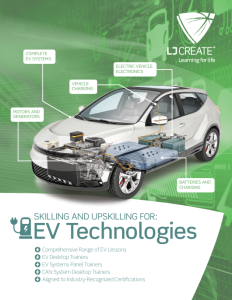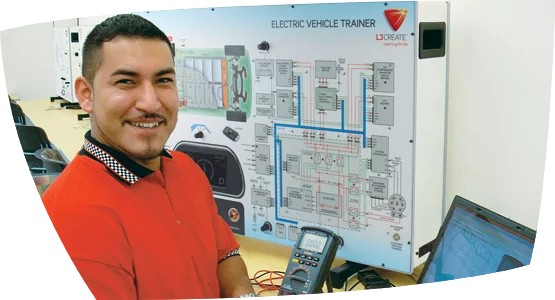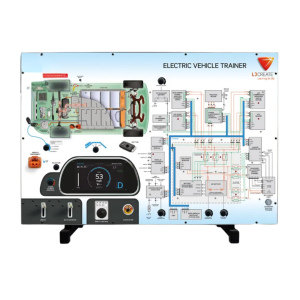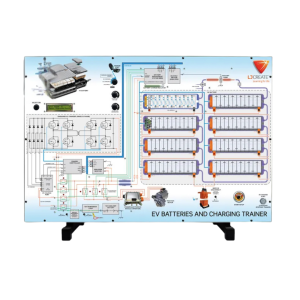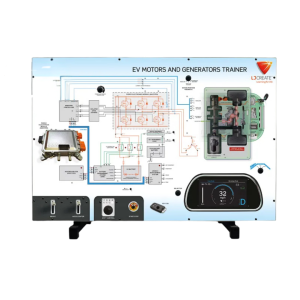
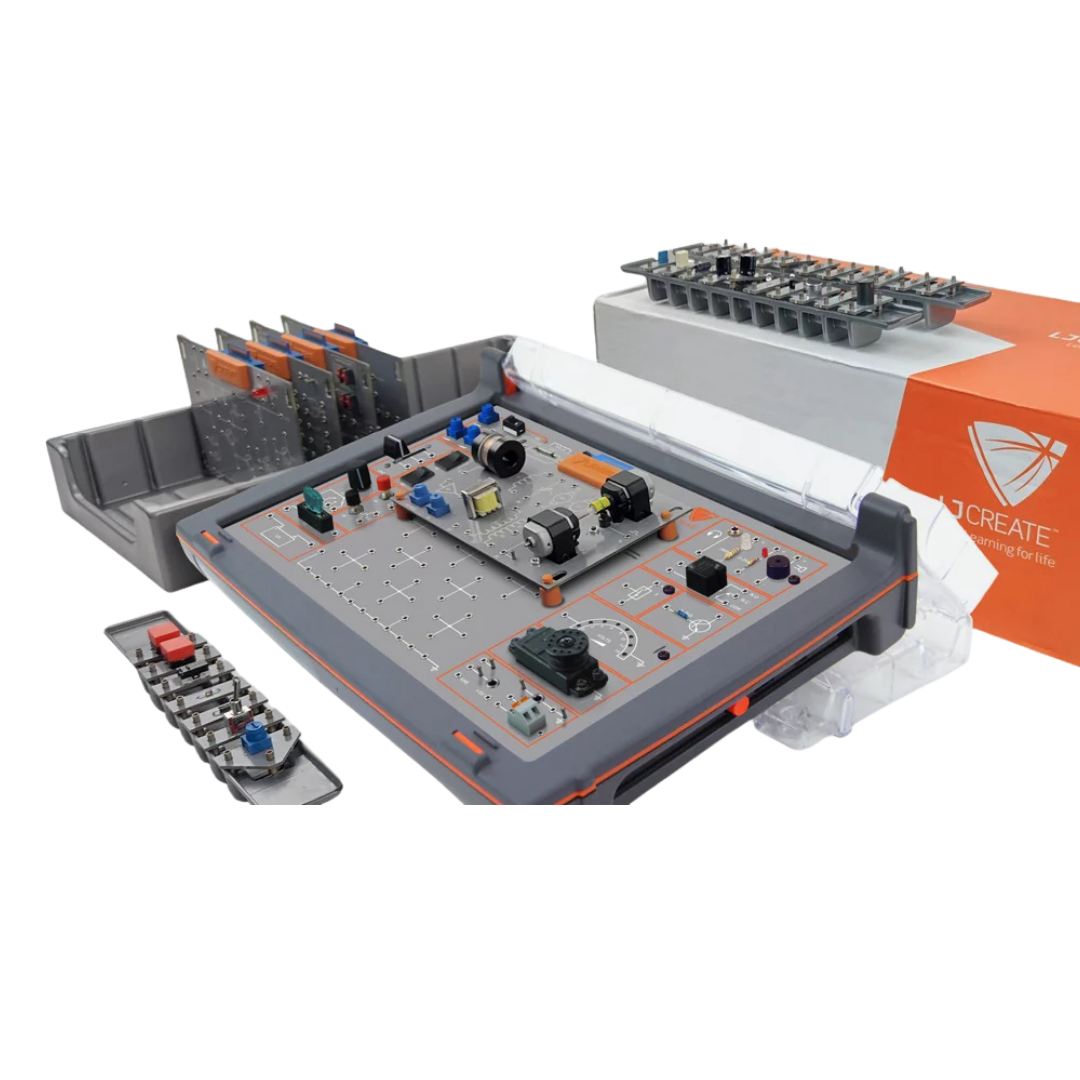
The Electric Vehicle Electronics Workstation (730-00) from LJ Create provides an advanced platform for studying the electronic circuits and devices used throughout automotive and electric vehicle systems. Students progress from fundamental electronic circuits into sensing, signal processing, motor control, power conversion, and other technologies important to modern EV electronics.
The workstation combines a circuit patching area and component set with five plug-in experiment cards covering Electronic Systems, Electromagnetism, Input Transducers, Analog Integrated Circuits, and Pulse Width Modulation Signals. Built-in switched faults also allow students to move beyond circuit operation and practice systematic electronic fault finding.
Features
- Five experiment cards target key automotive and EV electronic technologies.
- 28 mounted components support hands-on circuit construction and investigation.
- PWM and 3-phase circuits introduce EV motor control concepts.
- Automotive sensors provide experience with real sensing technologies.
- Built-in switched faults develop electronic troubleshooting skills.
- Circuit patching area lets students build and test additional circuits.
Electronic Circuits & Components
Investigate comparators, amplifiers, logic devices, transistor circuits, time delays, and other electronic subsystems.
Electromagnetism
Explore Hall effect sensors, electromagnets, solenoids, transformers, and DC motor and generator operation.
Automotive Sensors & Transducers
Investigate optical, temperature, humidity, current, pressure, Hall effect, and inductive sensing technologies.
Analog Integrated Circuits
Explore sensor ICs, voltage regulators, filters, phase-locked loops, and analog switching circuits.
Pulse Width Modulation & Motor Control
Investigate PWM signals, motor speed control, 3-phase waveforms, and 3-phase inverter driver circuits.
Rectification & Power Conversion
Explore 3-phase bridge rectification and DC smoothing used in electronic power conversion.
Electronic Fault Finding
Diagnose faults within sensor, electromagnetic, and signal-conditioning circuits.
Curriculum & Program Integration
This electronic vehicle workstation aligns with LJ Create’s AutoLab programs, which pair an engaging curriculum with hands-on learning.
The curriculum for this learning system includes:
- Hands-on training experiments and activities
- Interactive online curriculum and instructional resources
- Teacher support materials and guided learning content
The compact format makes it easy to use as a standalone automotive learning system or integrate into a larger automotive technology program.
Electric Vehicle Electronics Workstation (730-00) Product Details
System Includes
- Electric Vehicle Electronics Trainer (730-10)
- Five plug-in experiment cards
- Component set
- Connection lead set
- Storage case
- Digital curriculum
- Experiment Cards
Electronic Systems Card (320-01)
Investigates comparators, voltage amplification, logic inversion, Darlington transistors, time delays, and audio amplification.
Electromagnetism Card (320-14)
Covers reed switches, Hall effect sensors, electromagnets, solenoids, transformers, DC motors and generators, and electromagnetic fault finding.
Input Transducers Card (320-15)
Explores automotive photo sensors, temperature sensors, humidity and temperature sensing, current and pressure sensors, Hall effect sensors, inductive sensors, filters, and sensor circuit troubleshooting.
Analog Integrated Circuits Card (320-32)
Investigates thermal and optical sensor ICs, linear and switch-mode voltage regulators, switched capacitor filters, phase-locked loops, and analog switches.
Pulse Width Modulation Signals Card (320-50)
Explores PWM signals, variable frequency and duty cycle, motor speed control, 3-phase waveforms, inverter drivers, bridge rectifiers, DC smoothing, and signal-conditioning faults.
Component Set
The workstation includes 28 components mounted on durable carriers, including:
- Toggle switches
- 12V lamps
- Resistors
- Capacitors
- 100 mH inductor
- Thermistor
- Phototransistor
- Microphone
- Diodes
- Potentiometer
- Trainer Capabilities
- Circuit patching area
- Experiment card mounting area
- Switched fault insertion
- Servo motor
- Automotive fuse and holder
- Rocker and pushbutton switches
- Variable clock
- Linear voltage display
- Amplifier and buzzer
- Automotive relay
- DPCO relay
- LED outputs
- Transistor switch and relay
- Variable resistor
- +5V, +12V, and variable power supplies
- Oscilloscope test points
Requirements
Some learning tasks may require:
- Dual-trace oscilloscope
- Signal generator
- One or more digital multimeters
Technical Specifications
- Power Requirements: 110–240V, 50–60Hz