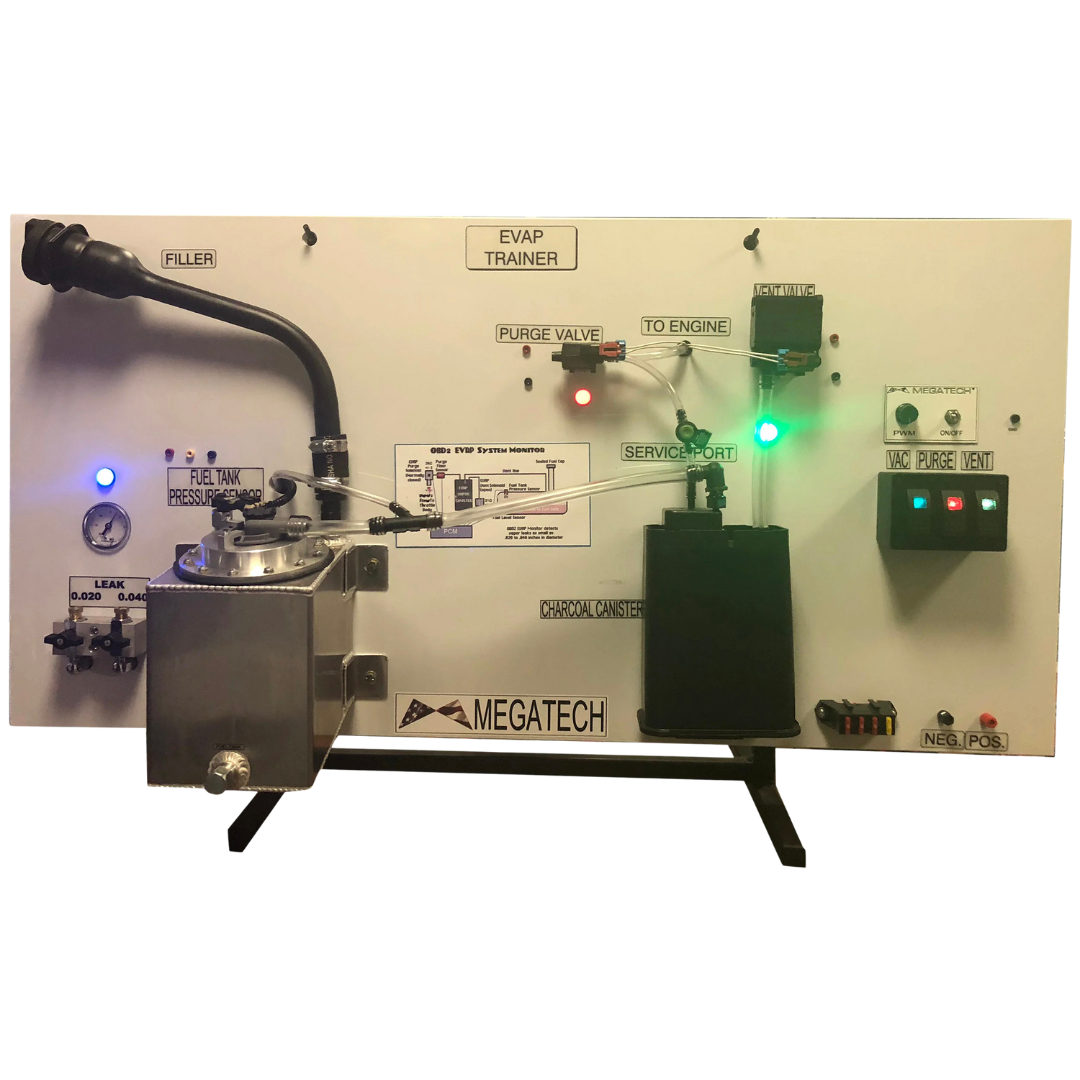
The EVAP/Leak Detection Trainer teaches evaporative emission control systems, one of the most common diagnostic challenges in automotive repair. Students will work with a complete EVAP system featuring a fuel tank with pressure sensors, a purge solenoid, and a vent solenoid. Using this automotive engine trainer, students will measure pressures, voltage, and sensor signals to build diagnostic skills needed to identify leaks, faulty sensors, and malfunctions, preparing them to enter the workforce equipped with troubleshooting experience.
Features:
- Complete functional EVAP system
- Fuel Tank
- Purge Solenoid with PWM activation
- Vent Solenoid
- Strategic test points for diagnosing
- Hands-on leak detection and diagnosis training
- Compact design suitable for the classroom
EVAP System Operation
Understanding how evaporative emission systems capture, store, and purge fuel vapors while maintaining proper fuel tank pressure.
Emission Control Principles
Learning the environmental and regulatory importance of EVAP systems and how they prevent hydrocarbon emissions from entering the atmosphere.
Purge Solenoid Control
Exploring PWM activation and how the ECU uses variable duty cycle signals to control vapor purge into the engine precisely.
Fuel Tank Pressure Monitoring
Working with fuel tank pressure sensors to understand how the system monitors for leaks and maintains proper tank pressure.
EVAP Leak Detection
Developing diagnostic skills to identify system leaks, faulty caps, cracked hoses, and other common EVAP failures.
Solenoid Testing and Diagnosis
Testing purge and vent solenoids for proper operation, electrical continuity, and response to control signals.
EVAP/Leak Detection Trainer Product Details
- Fuel tank, cap, and pressure sensor
- Purge solenoid with PMW activation
- Vent solenoid
- Testpoints for diagnostics throughout the system
- Mounting platform